
Crypto Data Online Complete Guide for Blockchain Education
The modern blockchain landscape has fundamentally evolved from a speculative retail market into an institutional value-settlement layer. Leading global asset managers, public treasuries, and regulatory agencies are deploying production-grade frameworks. For students, financial professionals, and technologists, building data literacy around public ledgers is no longer Crypto Data Online—it is the prerequisite for navigating the next generation of global capital markets.
Because public blockchains are completely transparent, irreversible databases, they eliminate the information asymmetry typical of traditional banking systems. Every transaction, asset transfer, and smart contract interaction is readable by anyone in the world with an internet connection. This guide establishes a structured educational framework designed to help you transform raw on-chain data into actionable financial intelligence.
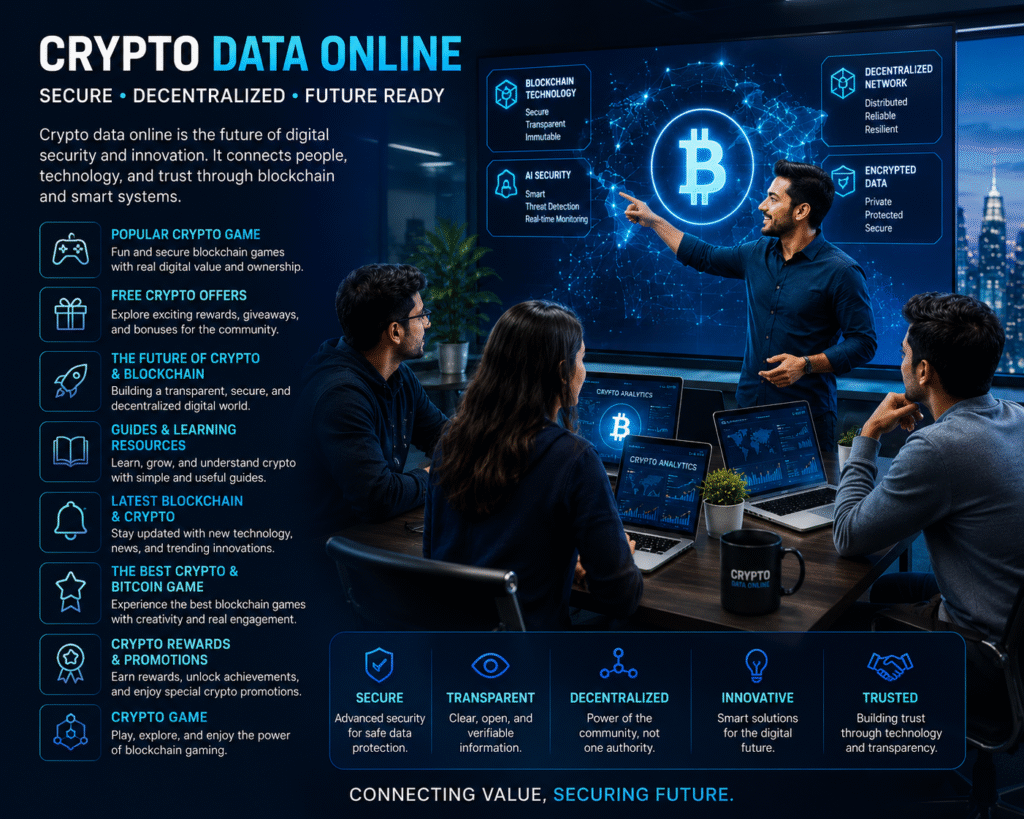
1. Structural Architecture: The Mechanics of On-Chain Data
To understand blockchain data, you must understand how data enters the ledger. A blockchain is a distributed ledger maintained by independent, global nodes that reach cryptographic agreement (consensus) without relying on a central authority.
Raw Transaction Request ──► Broadcast to Mempool ──► Validator Consensus ──► Cryptographic Block Linking
       (Wallet)               (Pending Queue)            (PoS / PoW)                (Immutable Ledger)
Data flows chronologically through specific operational states:
- The Mempool (Memory Pool): When a transaction is submitted, it does not immediately enter the blockchain. Instead, it sits in a public, localized waiting room known as the mempool. Analyzing the state of a network’s mempool provides real-time insights into congestion patterns, pending structural movements, and shifting priority fees before blocks are finalized.
- Cryptographic Hashing & Merkle Trees: Transactions within a block are parsed and arranged via Merkle Trees—a data architecture that condenses multiple data entries into a single, permanent cryptographic string called a root hash. This structural sequencing ensures that changing a single variable in a historical transaction would alter every subsequent block hash, making data tampering impossible without subverting the consensus of the entire network.
- Consensus Execution (Proof of Stake vs. Proof of Work): Networks like Bitcoin utilize Proof of Work (PoW), demanding hardware computations to confirm new data entries. Modern scaling layers and networks like Ethereum rely on Proof of Stake (PoS), where validators lock up native digital collateral to win the right to propose and record the next block of verified records. Tracking validator retention and staking density allows analysts to calculate the structural security budget of a live ledger.
2. Core On-Chain Data Metrology
Blockchain analytics requires mapping out clean quantitative metrics to gauge organic growth vs. synthetic activity. On-chain metrics are separated into three diagnostic categories:
A. Network Health & Scalability Metrics
- Transactions Per Second (TPS) vs. Time-to-Finality (TTF): While simple TPS counts capture basic transaction velocity, TTF measures the actual window required for a transaction to become irreversible.
- Gas Dynamics and Fee Demands: Fees are structurally determined by the supply of block space relative to computation demand. Analyzing the daily standard deviation of gas pricing allows you to map out structural network congestion.
B. Capital Distribution & Liquidity Metrics
- Total Value Locked (TVL): The amount of base collateral locked within an ecosystem’s decentralized applications. A rising TVL typically indicates deep pool liquidity and growing user confidence.
- Stablecoin Velocity & Supply Growth: Stablecoins represent immediate liquidity. Tracking net inflows of stablecoins onto a network reveals whether participants are allocating fresh funding or simply swapping existing volatile assets.
C. Address Cohort Behavior
- Address Profiling by Wealth Distribution: On-chain analytics software categorizes addresses into explicit brackets based on asset volume (e.g., retail holders with less than $\$10,000$ vs. institutional “whales” holding greater than $\$1,000,000$). Divergences between these cohorts often signal long-term structural accumulations.
3. The Professional Data Analyst’s Stack
Navigating this data effectively requires selecting the correct analytical toolkit based on your research goals.
┌──────────────────────────────────────────────────────────────────────────┐
│                          THE ON-CHAIN TOOL STACK                         │
├─────────────────┬────────────────────────────────────────────────────────┤
│ Block Explorers │ Etherscan • Solscan • Blockstream                      │
├─────────────────┼────────────────────────────────────────────────────────┤
│ Macro Platforms │ DeFiLlama • Token Terminal • Artemis                   │
├─────────────────┼────────────────────────────────────────────────────────┤
│ Data Engines    │ Dune Analytics • Flipside Crypto                       │
└─────────────────┴────────────────────────────────────────────────────────┘
- Block Explorers (Etherscan, Solscan): These are the baseline search engines for web3. They provide visibility into raw smart contract bytecode, execution logs, and detailed individual wallet tracking.
- Macro Aggregators (DeFiLlama, Token Terminal): These platforms translate fragmented transaction rows into readable economic charts. They offer cross-chain data standardizations that make evaluating a project’s price-to-sales ($P/S$) ratio or annualized fee revenue straightforward.
- Programmatic Analytics Engines (Dune Analytics): For custom research, Dune provides direct access to historical relational databases containing decoded blockchain tables. Users utilize relational SQL models to isolate specific protocol metrics.
4. Fundamental Valuation Frameworks
Evaluating a digital asset or blockchain protocol requires traditional corporate finance concepts adapted to open-source software architectures.
The Network Valuation Formula
Network utility can be cross-examined using Metcalfe’s Law, which states that the financial utility of a network is mathematically proportional to the square of its connected nodes ($V \propto N^2$, where $N$ represents unique active users). When asset prices decouple dramatically from active user scaling curves, it often signals an overvaluation.
Comparing Protocol Revenue Models
To determine if a decentralized application has a sustainable business model, look directly at how platform usage feeds economic value back to token holders:
$$\text{Protocol Revenue} = \text{Total Fees Generated} – \text{Supply-Side Incentives}$$
If a network generates millions in user fees but must emit an even larger dollar volume of inflationary tokens to bribe liquidity providers, its net operational revenue remains structurally negative.
5. Security Architecture, Risk Analysis, and Compliance
The ultimate milestone of blockchain education is mastering risk assessment. Because smart contracts automate value transfers without intermediaries, code vulnerabilities carry immediate financial consequences.
  [Security Lifecycle Vectors]
  ├── Pre-Deployment Auditing (AI Static Code Analysis)
  ├── Oracle Redundancy (Decentralized Feed Architecture)
  └── Post-Execution Monitoring (Automated Exploitation Halts)
Smart Contract Exploits & Audits
A smart contract is open-source code; its logic is completely public. Malicious actors scan deployment addresses for systemic logical bugs such as reentrancy flaws or integer overflows. Evaluating contract safety requires verifying that codebases have completed thorough audits from reputable cybersecurity teams and possess active bug bounties.
Oracle Vulnerabilities
Decentralized protocols use oracles to fetch real-world financial data feeds (like market pricing). When protocols rely on thin or centralized oracle sources, malicious actors can artificially pump asset prices on a single minor venue, triggering Crypto Data Online bad debt or unbacked liquidations across major lending platforms.
AI Integration and Compliance
Autonomous security tools now leverage advanced machine learning models to continuously inspect the global mempool for malicious smart contract interactions, isolating attacks before validation. Concurrently, regulatory guardrails in global markets demand strict transaction profiling to maintain compliance with Anti-Money Laundering (AML) standards.
6. Project-Based Educational Curriculum
The most efficient way to achieve verifiable mastery over blockchain data is to step away from theoretical documentation and transition toward project-based learning paths. Below is a progressive, 90-day learning roadmap structured around practical, data-focused metrics.
1.Phase 1: Raw Ledger Decoding:Duration: Days 1 – 30.
Focus exclusively on manual data extraction using block explorers. Pick 5 separate transactions across different protocols and map out their entire execution lifecycle: trace the input address, inspect the contract state changes, dissect gas expenditures, and explain the events emitted by the smart contract.
2.Phase 2: Fundamental Macro Modeling:Duration: Days 31 – 60.
Utilize aggregators like DeFiLlama and Token Terminal to build comparative financial models. Select three competing Layer 2 protocols and chart their rolling 90-day retention rates, cost-per-transaction ratios, and capital efficiencies (TVL divided by daily transaction volume).
3.Phase 3: Relational SQL Query Engineering:Duration: Days 61 – 90.
Create a developer account on an open data engine like Dune Analytics. Write custom SQL scripts querying raw transaction logs to build an automated, real-time dashboard tracking the liquidity distributions and trade slippage profiles of a specific decentralized exchange pool.
The Analyst’s Mandate: In an industry prone to noise, data remains the single source of truth. By building a daily habit of viewing raw transactions, parsing network health statistics, and verifying code execution via explorers, you decouple your perspective from hype and master the underlying infrastructure of modern global finance.
About The Author
